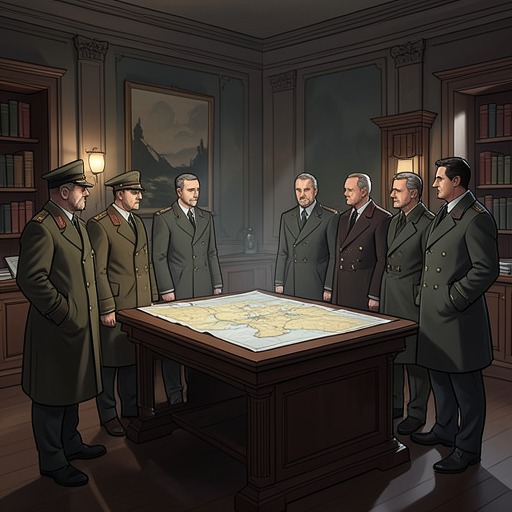
Panizzardi telegram
An Officer and a SpyThe Panizzardi telegram is a cipher message sent by Alessandro Panizzardi to the General Staff in Rome on 2 November 1894. Its significance lies in the gulf between its actual meaning and the version Charles-Arthur Gonse attached to it: the misleading text appeared to implicate Alfred Dreyfus in dealings with Germany, while the accurate decryption instead suggested that Panizzardi was unsure whether Dreyfus had any connection to him. The telegram thus became not merely a record of communication, but a test of how intelligence could be made to confirm a belief it did not support.
The message in the archive
The telegram was dispatched at three o’clock in the morning. Its surviving coded text is a sequence of numerals addressed to the General Staff in Rome and signed by Panizzardi. Picquart encounters it among documents that have been glued together and gathered into the intelligence archive. The papers around it include correspondence between foreign military and diplomatic figures, an envelope of cinders, and many private letters. Set among this heterogeneous record, the cipher carries a particularly consequential institutional annotation: its decoded text is clipped to it, written out by Charles-Arthur Gonse.
That attached version says that Captain Dreyfus has been arrested, that the Ministry of War has evidence of his dealings with Germany, and that necessary precautions have been taken. Picquart copies both the cipher and Gonse’s solution into his notebook, placing the numerical message on one page and the purported decoding on the other. The physical arrangement makes the disagreement legible: the claim is not hidden in a distant report but set directly beside the text offered to authenticate it. Yet the archive’s juxtaposition does not establish that the translation is sound. The telegram’s evidentiary force depends on who decoded it and what those readers were prepared to believe.
A translation at odds with the cipher
Étienne Bazeries, whom Picquart consults about the message, rejects Gonse’s version. He produces the decoded text beneath the numerals: “If Captain Dreyfus has had no dealings with you it would be appropriate to instruct the ambassador to publish an official denial in order to avoid comments by the press.” This is not a report that Panizzardi knows Dreyfus to be a German contact. It is a conditional proposal for an official denial if Dreyfus has had no dealings with him. Bazeries explains that Panizzardi was, in fact, in the dark about Dreyfus, the direct opposite of the conclusion Jean Sandherr drew from the message.
The circumstances of the telegram’s transmission help explain how the mistaken interpretation arose. Sandherr had arranged for Dreyfus’s name to be leaked to the newspapers as the identity of the man arrested for espionage. He expected the person employing Dreyfus to panic and contact superiors. When Panizzardi was followed to a telegraph office in the middle of the night, Sandherr treated the dispatch as confirmation that his tactic had succeeded. But the message’s actual wording did not deliver the confirmation he wanted. The telegram therefore records a chain of inference in which a planted newspaper report shaped expectations before the cipher was read: surveillance supplied an apparent occasion, and the interpretation supplied the supposed proof.
Verification and official circulation
According to Bazeries, the disagreement was tested rather than settled by assertion. Sandherr refused to accept the initial decryption and insisted that a word must have been read incorrectly. He took the matter to higher levels and arranged for an agent to give Panizzardi fresh information about an unrelated subject, prompting a second cipher message to Rome that used certain technical terms. After that message was also broken, the procedure had taken nine days from beginning to end. Bazeries presents this cross-check as confirmation that the reading was correct and resists being drawn into reopening the matter. The second message is not the same telegram, but its role in the account is to establish a method by which the first could be checked.
The telegram’s institutional history remains part of its meaning. When Picquart copies Gonse’s version for Bazeries, the discrepancy provokes an angry response and reveals that the document has already been the subject of dispute. In a later exchange, Billecocq says that he remembers handing the relevant item to the minister himself, General Auguste Mercier. The account does not specify its precise physical form at that moment, but the statement places the disputed material in the hands of a senior official, rather than leaving it as an obscure archival annotation. What began as a cipher from Rome had become an item circulated within the French military leadership.
Significance in the case
The telegram’s force comes from the difference between communication and the story imposed upon it. Its authentic wording does not establish Dreyfus’s dealings with Germany; instead, it records Panizzardi considering how to answer press speculation if Dreyfus had no dealings with him. The attached solution transformed that uncertainty into an apparent admission. Read alongside the documented leak and the subsequent verification, the object exposes how an intelligence document could acquire authority through custody and annotation even when its wording contradicted the conclusion attached to it. Its place in the case is therefore double: it was presented as evidence against Dreyfus, and, once accurately decoded, it became evidence that the military interpretation had outrun the message itself.